I remember being a kid in the back seat of the family car, driving along the highways of Austin at dusk. Darkness settling into the sky, on the horizon I see something bizarre rising above the maze of familiarly labyrinthine overpasses and ramps. At first it looks like smoke, except it doesn’t disperse, and it holds its shape as it climbs into the evening sky. A dense black filament suspended against the fading light.
We drive closer and the form sharpens. My father solves the mystery while glancing at the spectacle from behind the wheel: “Bats!” Tens of thousands of them flittering into the greying sky. No. Hundreds of thousands. Maybe millions? They pour upwards from concrete shelves beneath the overpass and form a marvelously continuous stream. The column thickens and thins, snakes and contorts upward. It doesn’t break. It simply keeps coming, a living rope stretching beyond my field of vision. I follow it into the distance with my eyes as far as I can, until it dissipates into the dusk.
Yesterday I drove the same stretch of highway again in the evening. I hadn’t in a long time. The bats were there again. Pouring from the concrete, rising into the darkening sky, that same black rope I remembered. I saw them periodically after that first encounter as a kid, and over time the sight grew familiar. Part of a background. Like traffic or weather or the flocks of grackles in a parking lot. Bats at dusk in Austin, of course. Sure, I’d turn to look at them from my window, but by the third time they wouldn’t hold my attention for longer than a minute or two. I never questioned whether they would be there. I never thought about what it meant that they were.
Now it all feels so different. I know the numbers and I know how rare this has become. Sitting in traffic watching them stream into the sky in 2026, I felt as if the sight was too much. Bats shouldn’t feel like a miracle. But that is what they are. And it is high time we all understand why.
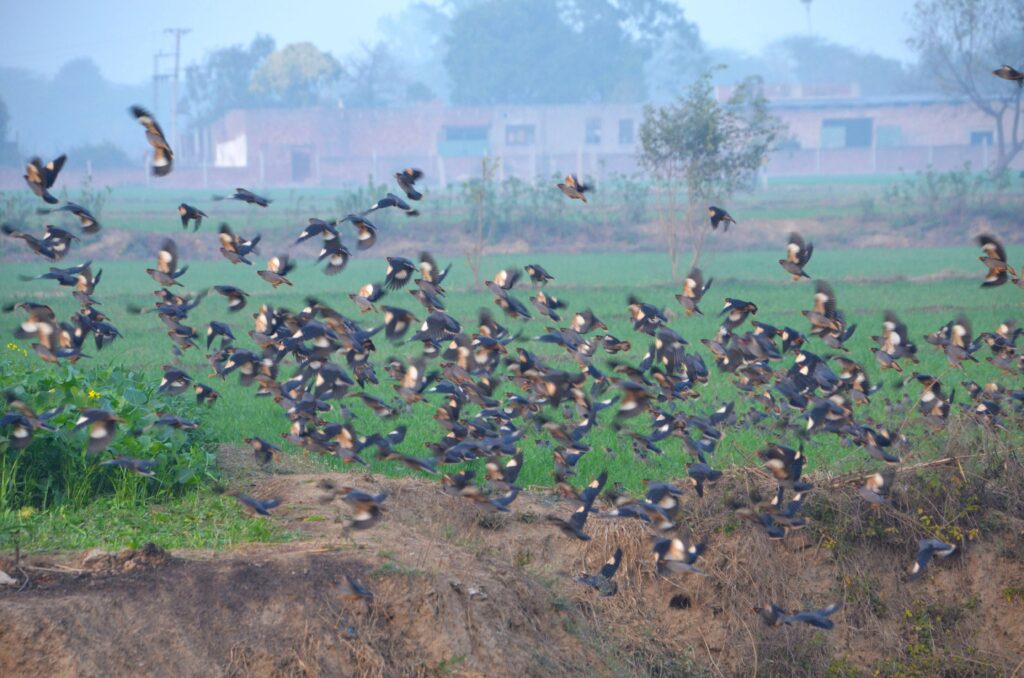
A snapshot of a massive flock of several hundred Bank Mynas in an agricultural plot of Lahore. Taken with my Nikon D5100 in December 2024.
I have been thinking about mass. Biological mass. The weight of living things on this planet and how we measure what exists. When you look at the numbers group by group, a pattern emerges.
Start with amphibians and reptiles. We have almost no direct use for them. We don’t farm them at scale, don’t breed them in billions, don’t consume them as a staple. And yet their biomass has been so thoroughly reduced that the most comprehensive census of life on Earth considers their contribution to total animal biomass “negligible” (Bar-On, Phillips, and Milo 2018). Amphibians are the most threatened vertebrate class on the planet, with over 40 percent of species globally threatened (Luedtke et al. 2023). They are collapsing not because we want them but because we have poisoned their water, drained their wetlands, fragmented their forests, and warmed their climate. We have no use for them, so we simply swept them aside.
Insects, crustaceans and arachnids are next. We can consider all of them (and some others) by looking at the group that is arthropods. Arthropods represent roughly half of all animal biomass on Earth, an estimated 1 gigaton of carbon (Bar-On, Phillips, and Milo 2018). A single species of termite can outweigh all wild birds combined. A single species of Antarctic krill contributes as much biomass to our planet as every living human being. Insects are the substrate on which terrestrial ecosystems run: they pollinate 80 percent of wild plants, they feed 60 percent of bird species, they decompose and cycle the nutrients that keep soils alive. We don’t farm them in any meaningful way. And yet a landmark study across 63 German nature reserves found that total flying insect biomass had declined by more than 75 percent over just 27 years (Hallmann et al. 2017). Subsequent monitoring confirmed that insect biomass has not recovered and remains at those depleted levels (Mühlethaler et al. 2024). In Puerto Rico, arthropod biomass in a protected rainforest crashed by 10 to 60 times compared to surveys from the 1970s. We have almost no economic use for insects and yet we are annihilating them through the accumulation of everything else we do: pesticides, habitat conversion, light pollution, climate disruption.
Now consider fish. Here the dynamic shifts. Fish represent approximately 0.7 gigatons of carbon, the second largest animal group after arthropods (Bar-On, Phillips, and Milo 2018). Unlike amphibians and insects, we want fish. We eat them. And so, alongside the collateral destruction, there is now active replacement. Farmed fish production has overtaken wild-caught fish for the first time. Industrial fishing has depleted an estimated 85 percent of commercial fish stocks. Ninety percent of the ocean’s large predatory fish, the tuna, the marlin, the sharks, are gone. What we want, we take until it is scarce, and then we manufacture a substitute.
Now birds. The biomass of domesticated poultry, dominated by chickens, is roughly three times that of all wild birds on Earth combined (Bar-On, Phillips, and Milo 2018). Seventy percent of all bird biomass is poultry. The remaining 30 percent is everything else. Every eagle, every heron, every warbler, every albatross crossing the Pacific. All of them together weigh less than half of what our chickens weigh. By mass, for every 1 kilogram of wild bird on Earth, there are roughly 2.5 kilograms of poultry. It is a systematic replacement of wild with domesticated.
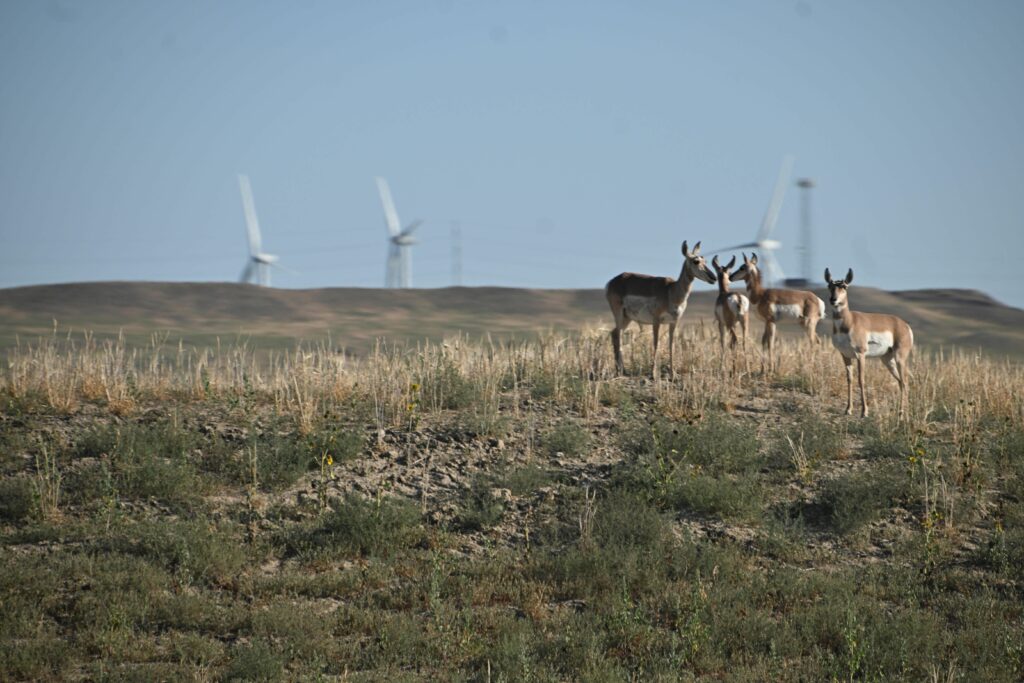
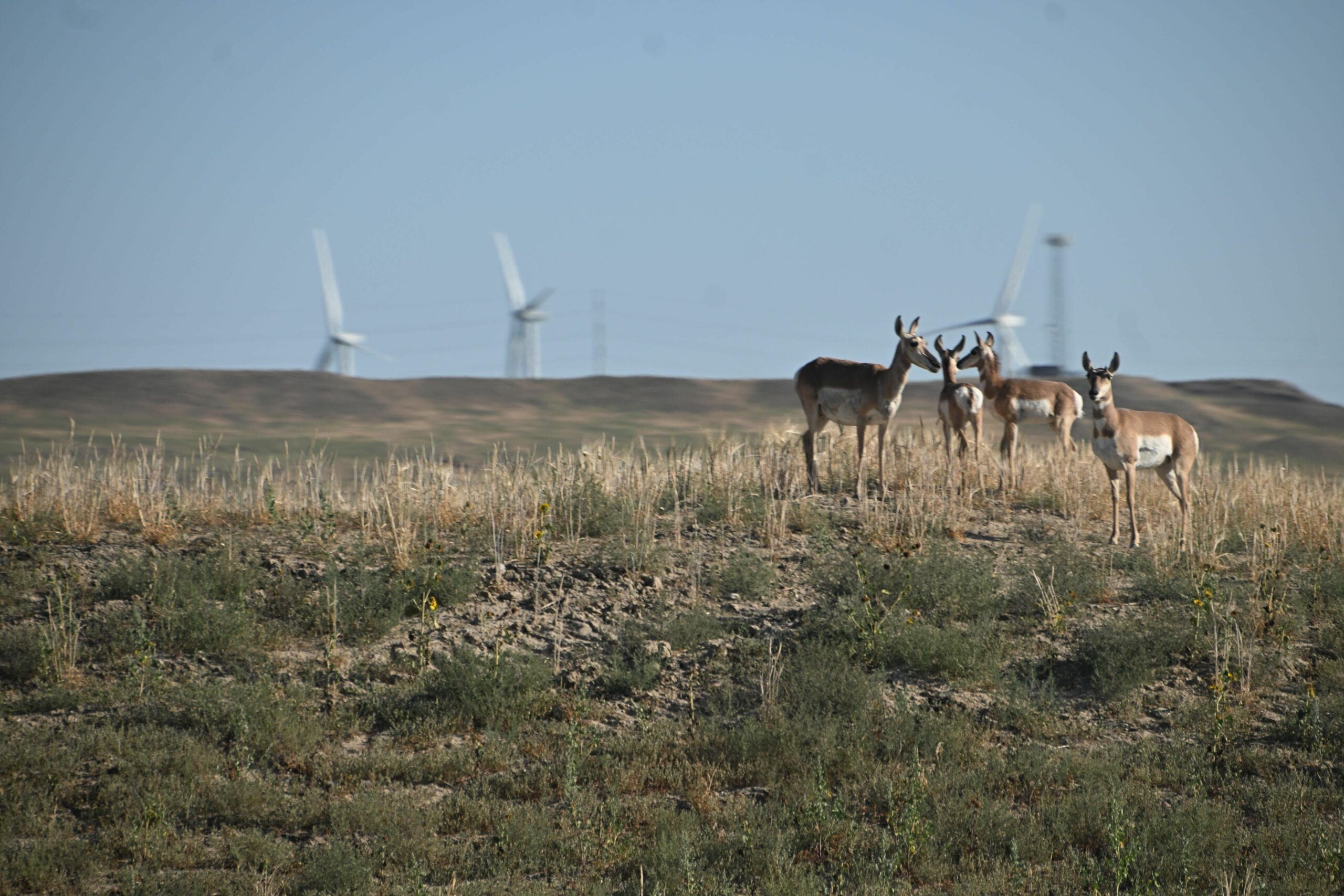
A herd of American Pronghorns in the Great Plains of Wyoming, now dotted with wind turbines. Taken with my Nikon Z50II in July 2025.
That alone should give us significant pause, but what of our own group? Our fellow mammals? Well, the picture for them is worse. Far worse. The most recent estimates show that humans account for roughly a third of all mammal biomass on Earth (Bar-On, Phillips, and Milo 2018; Greenspoon et al. 2023). A single species making up 34% of all mammalian flesh. Livestock account for well over half. They are our cattle, pigs, sheep, goats, dogs, cats. Cattle alone outweigh all wild terrestrial mammals by about 21 to 1; cattle biomass is approximately 420 million tons while all wild land mammals combined are roughly 20 million tons (Greenspoon et al. 2023). The world’s domestic dogs, by themselves, weigh about as much as every wild land mammal on the planet. Every wolf, every elephant, every tiger, every bear, every deer. All of them together don’t even equal our pets. Wild mammals, all of them, land and marine combined, make up only 4 to 5 percent of total mammalian carbon. Of that fraction, just 2 percent is wild terrestrial mammals, while 3 percent are wild marine mammals (Greenspoon et al. 2023). Mammals are the group we have the most uses for, and consequently the group we have most completely dominated, replaced, and reorganized around ourselves.
The pattern is stark. For the animals we have no use for, we destroy them as collateral damage and an afterthought. For the animals we do find useful, we replace them. We hollow out the wild populations and fill the void with domesticated equivalents. The less useful to us, the more unceremoniously their populations contract and capitulate. The more useful, the more thoroughly we substitute. Either way, the wild loses. And the further along that spectrum of usefulness you look, the more extreme the displacement becomes, from negligible amphibian biomass to the 96-to-4 mammalian split that defines the world we now inhabit.
I look upon this and it’s disorienting beyond belief. In the ledger of what actually exists on this planet, measured by mass and energy and carbon, the overwhelming majority of animal life either belongs to us, has been bred by us, or is in decline because of us. The wild is what remains in the margins.
This inversion happened fast. Within centuries. Within living memory if you extend it just a few generations back.
I sat with these numbers for a long time before I could think past them.
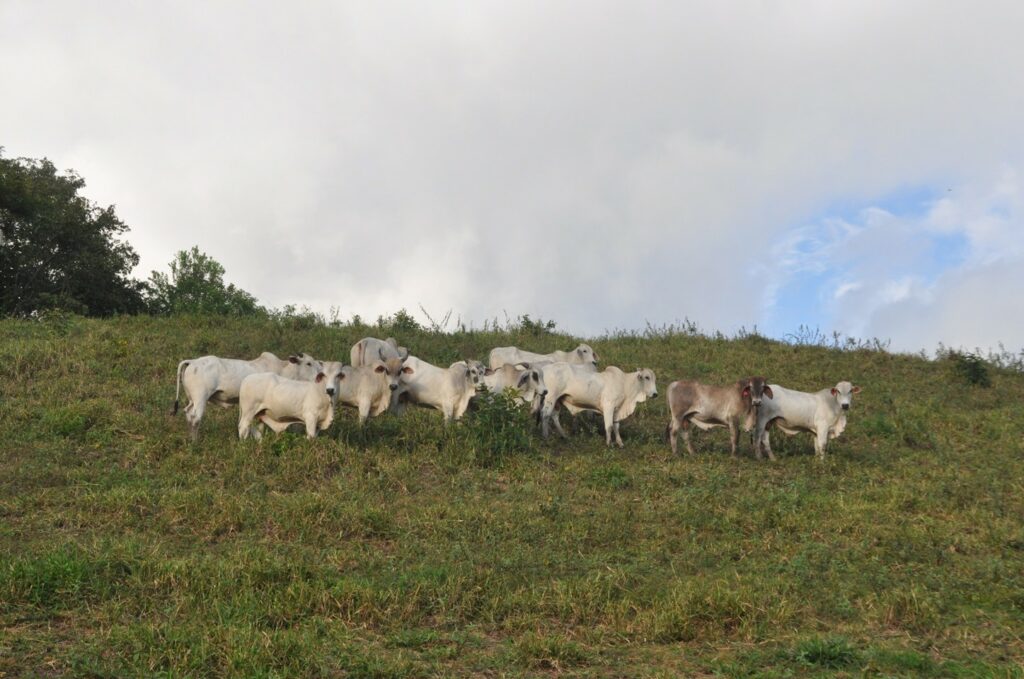
Cattle in a stretch of what was once rainforest, turned into grazing pasture in Costa Rica. Taken with my Nikon D90 in November 2022.
How far astray have we gone and from what? What should the world look like in the first place? I think about baselines. What we consider a healthy planet. The ideal a conservationist may wish to return to from whatever erosion of it we are living in.
When I was a child, I thought the bats streaming over Austin were simply part of how things were. Permanent. Inevitable. I didn’t quite realize that what I was seeing was already diminished from what my grandparents might have seen. I didn’t pay any mind to the fact that their world was already diminished from what came before. Each generation hemorrhages a fraction of the world’s biological complexity and calls it a whole. Ecological amnesia. But we can overcome this weakness if we care to inspect our baseline references. The ideal we compare our lived realities to when it comes to ecology.
So, let’s do that. You can take your pick of baselines to compare today’s biosphere to. The personal one: the world of your childhood, the number of insects on windshields during summer drives, the density of birdsong at dawn. The pre-industrial one: three centuries back, when large trophic systems still functioned fairly unbroken, and rivers remained unfragmented. The early Holocene: ten thousand years ago, when wild herbivores and predators dominated mammalian biomass and energy flowed through autonomous webs rather than channels we directed. The late Pleistocene: twenty to fifty thousand years back, when our prehistoric ancestors braved the Earth, but human biomass was negligible compared to wild mammals. The planet belonged to mammoths, giant ground sloths, cave bears, dire wolves, animals so large and numerous they shaped entire landscapes simply by moving through them. This was the world our senses evolved to understand. Any further back and it wouldn’t quite be relevant to our story.
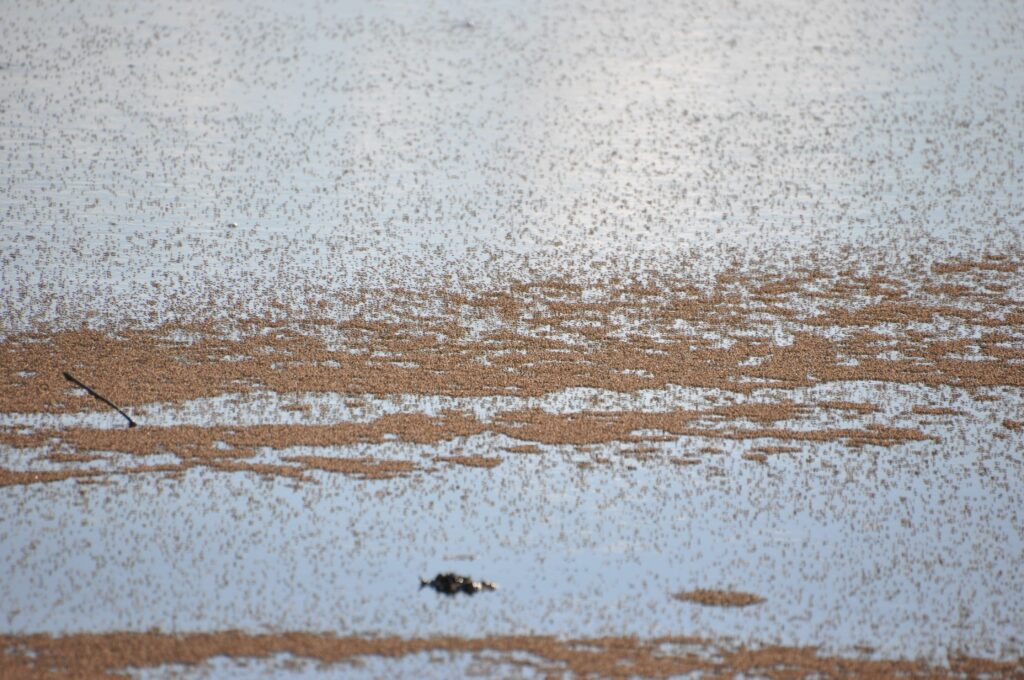
Mayflies swarm over the calm surface of an artificial pond in Central Texas. Taken with my Nikon D5100 in May 2024.
No matter where you draw your line, you can see the contraction of “normal” with every step forward. A one-way journey. Blindingly fast in geological terms, yet slowly enough for people to forget their parents’ ecological realities. Since our proliferation across the globe, we have been living in the greatest period of condensed biodiversity loss since the asteroid impact that killed the dinosaurs (and every animal larger than a dog) 66 million years back. This was the event that replaced the reigning reptiles with mammals. So cataclysmically significant are the changes that mass extinctions, like this one of our own making, can bring. Not to mention, it took the Earth millions of years to recover. The time scales involved are simply too long for there to be any comfort in life rebounding and re-evolving the complexity of ages past. Speaking in human terms, what’s gone is gone.
All biomass is stored solar energy. Sunlight captured by leaves, turned into plant matter, eaten by insects, eaten by bats. Every bat in that column over Austin is photosynthesis made flesh. That energy could have been diverted into crops for us or feed for cattle. Its presence in wild form means a chain of transfers remains intact. Habitat hasn’t been fully converted. Some portion of the planet’s productivity has escaped our appropriation.
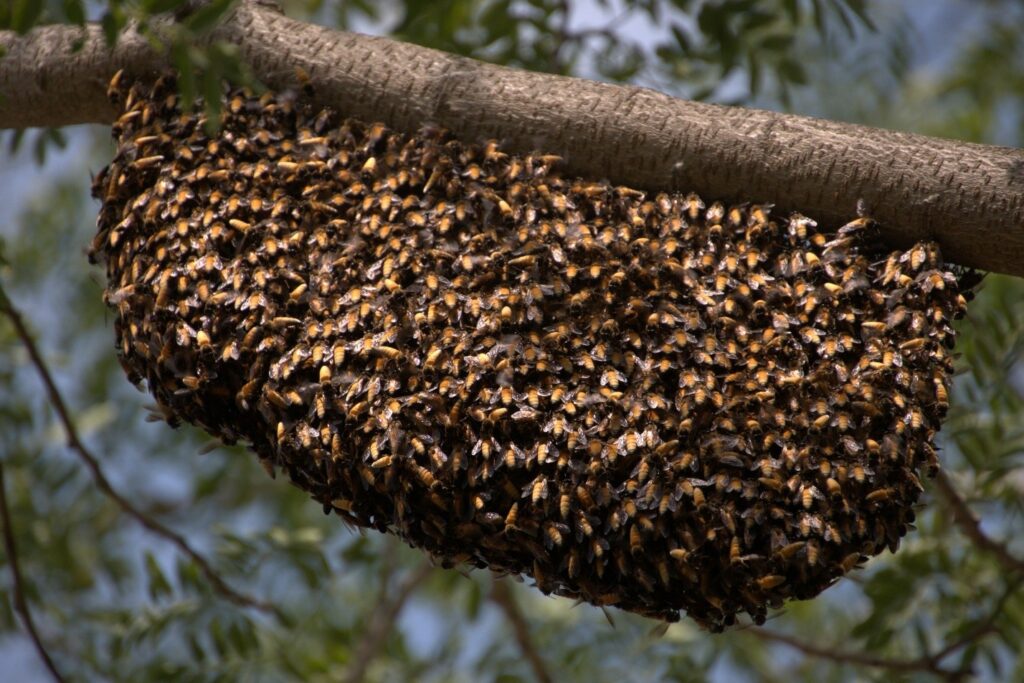
A wild hive of Giant Asian Honeybees in a reserve forest outside Lahore. Taken with my Nikon D5100 in June 2024.
But globally, most hasn’t. Agriculture occupies roughly half of habitable land. Wild herbivore biomass has been replaced by livestock sustained only by our inputs of grain and water and medicine. Predators are systematically removed. Complexity is traded for simplicity, monotony, efficiency. Forests are converted to pasture. Grasslands converted to crops. Wild carbon replaced by domesticated carbon. The animals are still there. Maybe there’s even more total mammalian biomass than “before”, but they’re different animals. Now the planet overwhelmingly bears animals we control and whose existences depend entirely on us.
In Lahore, on one of my searches for wilder spaces and wildlife to photograph, I came upon a colony of flying foxes roosting in the old trees of a public park. They were planted decades ago for shade, beauty, reasons that had nothing to do with local fauna. The bats had claimed them entirely. Branches sagged under their weight and the canopy was black with bodies. It was as if these trees bore large, dark, leathery fruit from every branch. Leaves had vanished beneath fur and folded membrane. And I won’t forget the sound. It’s this dense, layered screeching from the trees. I heard it before I understood what I was looking at. It felt like chancing upon a treasure.
The sight overwhelmed me. Too extraordinary for what should be ordinary. Trees here should hold these animals. They should be full of their sleepy roosting bodies in the daylight. But knowing what I know about how drastically we’ve shifted the balance, seeing it happen brought about a slurry of complicated feelings. Excitement, melancholy, wonder, and desperation, hoping that they will be here in another twenty years’ time. I make sure to revisit that colony every time I am in Lahore.
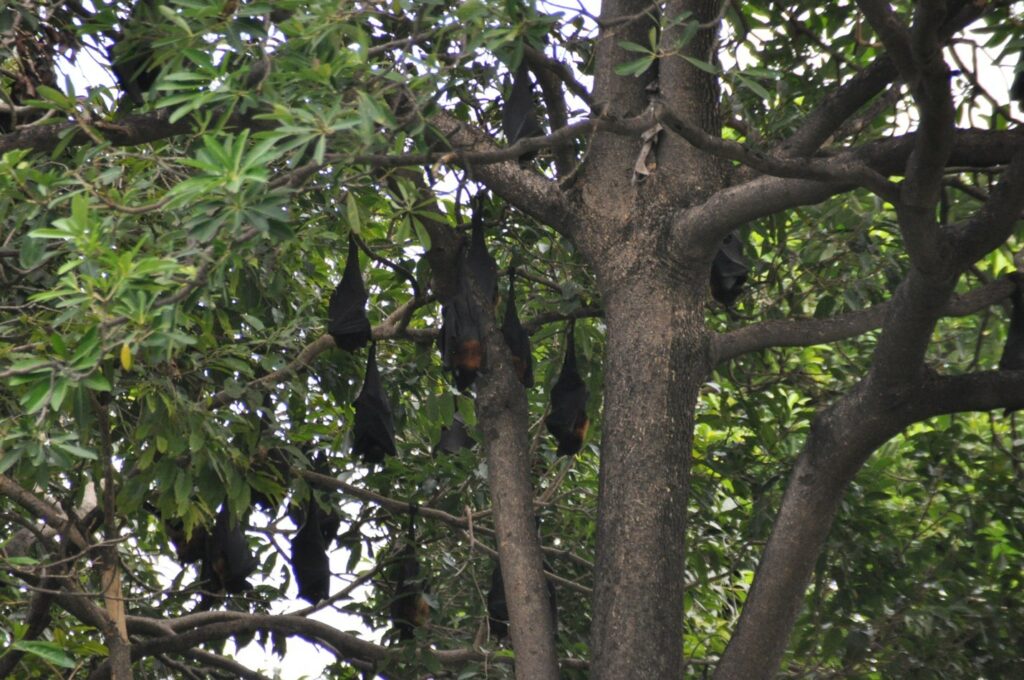
Indian Flying Foxes in Lahore. The roost I come to see every time I visit. Taken with my Nikon D90 in June 2023.
In a world where wild mammals make up only 4 to 5 percent of mammalian biomass, every visible concentration of native wildlife is rare. Statistically improbable. Every flock, every herd, every swarm is evidence of incomplete conversion. A pocket of resistance. Energy that has escaped the reassignment we have conducted on this planet.
Our perceptual systems evolved in high-biomass environments. Abundance is our inherited expectation. We are built to take in the sights of flocks and swarms and herds. We are built to jerk our heads toward the sound of a leopard in the darkness. But that calibration is outdated. We are living in a different world now than the one our senses expect. This is new territory; A world where human-directed biomass is the norm and wild abundance is the exception.
And yet. The bats still pour from beneath the overpasses. Fish still school in the sea in dazzling numbers. The wildebeest still carry out their annual migrations in herds stretching to the horizon.
These sights carry the weight of everything that had to be destroyed for them to become this rare and precious and improbable. An ecosystem is assembled slowly, compounding over deep time. Soil depth accumulates at millimeters per century. Fungal networks build species by species, relationship by relationship. These examples of how much time ecosystems take to develop their intricacies are endless, in fact they cross into timescales we humans can’t properly fathom. A mass congregation of animals is the yield on that deep-time investment. The dividend. Proof that the system still works and that trophic pathways haven’t been entirely severed. That genetic lineages continue unbroken, despite us dooming such phenomena to be afterthoughts in the new grand human scale of things.
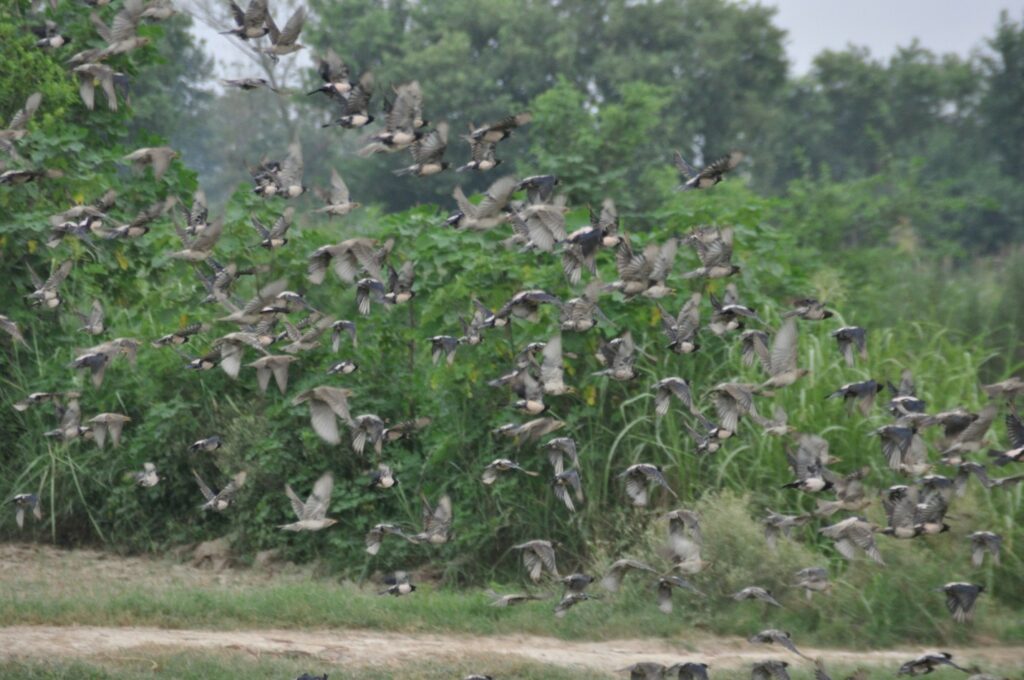
A large flock of hundreds of Rosy Starlings in the agricultural fields outside Lahore. Taken with my Nikon D90 in June 2023.
Every native animal carrying out its life in its ecosystem is precious retention of complexity in a simplifying world. In a world so thoroughly subjugated by man, I stop and marvel every time I see a sight of biological mass. Because yes, it is a marvel that some processes continue outside our direct command and escape liquidation. Despite everything we have done to reorganize the planet around ourselves.
When I see wild creatures now, I see them as what they are: individual miracles. Miracles in the sense of statistically massively improbable under current conditions. Miracles in the sense that habitat remains for them, that insect populations remain sufficient to feed them, that roosting sites haven’t all been sealed, that the chain of energy transfers from sunlight to plant to insect to bat remains unbroken. I think of the congregations that no longer form. We know what it looks like when the chain breaks. The Passenger Pigeon flocks that used to blot out the sun. The countless Great Auks that nested in the millions in their island colonies. These are the animals that no longer carry out their lives because we have transmuted the space they used to take, the biomass they had reserved, into the proliferation of something else.
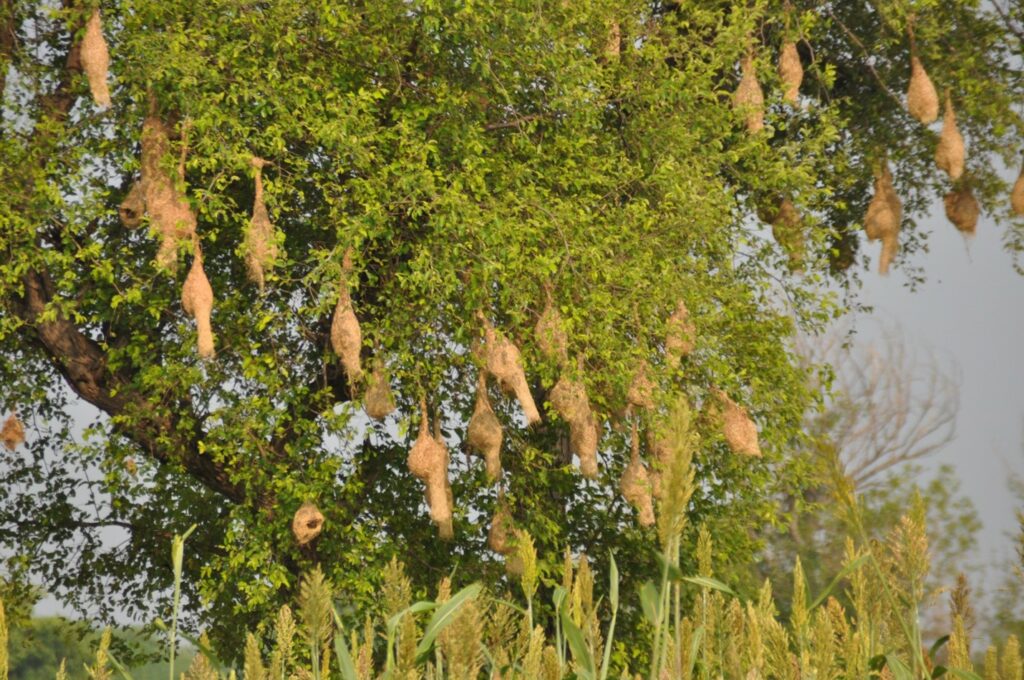
Nests of the Baya Weaver, built on a tree at the edge of a crop field in Lahore. Taken with my Nikon D90 in June 2023.
But I feel gratitude too that some pockets of this planet’s four-billion-year epic have survived our reach.
The Anthropocene has inverted the baseline. Wild biomass is no longer the structural norm of Earth’s surface. It is the remainder. And one must think about what holds this new arrangement in place. Who it serves. Because the reorganization of Earth’s biomass is, of course, not an abstraction. It is not something that happened to the planet while we stood by and watched. It is scaffolding. It is the infrastructure beneath a way of life. Your way of life. Mine. The life of comparative plenty that you and I enjoy when measured against almost any generation that preceded us.
That cheeseburger exists because a prairie was converted to cattle pasture. The palm oil in your pantry exists because a rainforest in Borneo was burned to the ground, taking with it every orangutan, every hornbill, every organism that once called it home. The pineapple shipped to your supermarket in January, the avocado flown in from a deforested mountainside in Michoacán, the shrimp farmed in a pond that was a mangrove estuary ten years ago. These are not incidental to the biomass crisis. They are the biomass crisis made into products, wrapped in plastic, and placed on a shelf for your convenience. The 96-to-4 split didn’t happen in the abstract. It happened so that the global economy, and your place in it, could function as it does.
But here is what makes it worse: the costs of this arrangement are not distributed the way the benefits are. The destruction is global. The warming, the habitat loss, the collapsing insect populations, the acidifying oceans. These fall on everyone. The subsistence farmer in the Sahel whose rains no longer come on time is paying dearly for this. The coastal fisherman in Bangladesh whose catch dwindles every year is paying for it. The Indigenous community in the Amazon watching its forest be sold out from under it is paying for it. They pay with their livelihoods, their food security, their futures. But the products of that destruction, the abundance it generates, flows overwhelmingly to a minority of the world’s population. If you are reading this in a country where a single supermarket aisle offers you 250 varieties of cereal and a dozen brands of yogurt (the United States, most of Western Europe, Australia, Japan, a handful of others), you are almost certainly among the beneficiaries. The rest of the world absorbs the consequences of a consumption pattern it did not create, and from which it does not even proportionally benefit.
This is not guilt for its own sake. I am thoroughly uninterested in the blame game. I am interested in encouraging clarity. We need widespread understanding that the space wild creatures have lost is the space we now occupy, and that by accident of birth, some of us occupy far more of it than others.
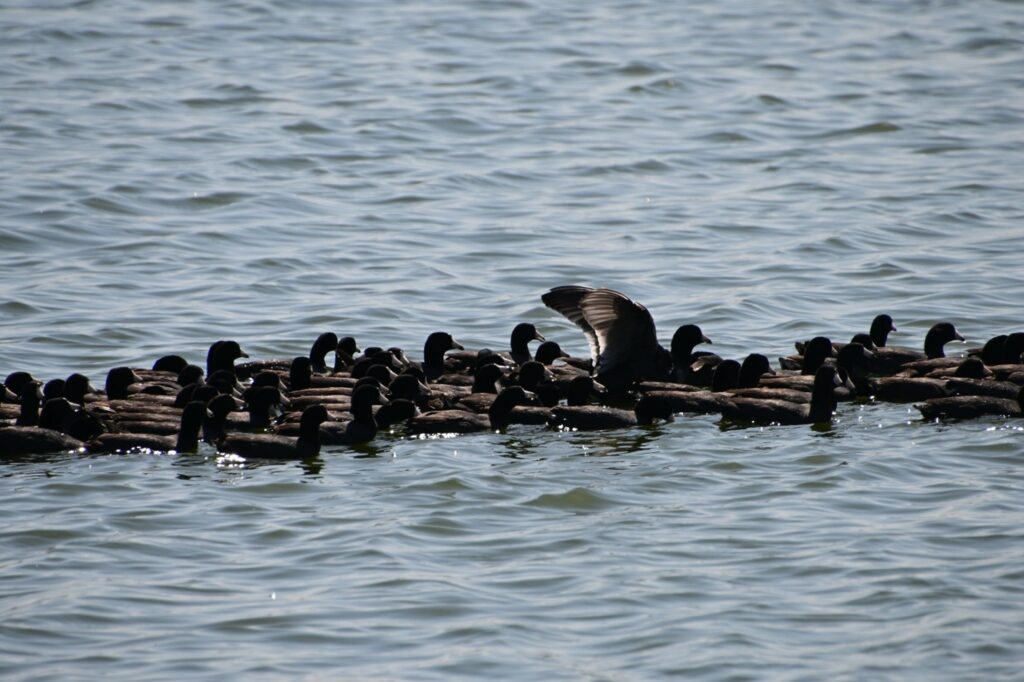
American Coots assemble in a tight-packed flock on an artificial Central Texan lake. Taken with my Nikon D5100 in May 2024.
We need widespread understanding that every pocket of remaining native wilderness is a miracle. Every bumblebee in a garden, every rattlesnake in a prairie, every lion in the savannah. These are not remnants in the passive sense. They are ongoing acts of persistence against a planetary system that has been redesigned, from the ground up, to serve us. That they continue to exist is extraordinary. That the chain of energy transfers from sunlight to plant to insect to bat hasn’t been fully severed everywhere is something worth marveling at. These are the pockets of complexity we haven’t yet simplified into more economically justifiable monoculture and concrete.
So the question becomes personal. What do we owe what remains?
We owe them space. We are dominant beyond any precedent in the history of life on this planet. We have claimed so much that what is wild persists only in the gaps we haven’t yet found profitable enough to take. Those bats in Austin survive because they found openings in our infrastructure that we didn’t seal. The question is whether we will begin to leave gaps on purpose. Can we look at the space we control (and we control nearly all of it) and decide that some portion doesn’t need to serve us? That it can be given back to the metabolisms that ran there long before we arrived?
Loosening our chokehold on the wild creatures of the world doesn’t solely require grand gestures such as protected land akin to national parks or nature reserves, though it requires that too. It requires the smallest concessions. The margins we decide to leave alone. The ground we let go wild. The products you and I refuse to buy when their existence requires the liquidation of someone else’s habitat. And it requires those of us who benefit the most from this arrangement to concede the most.
Every patch of habitat, however modest, connects to something larger. These small spaces accumulate into corridors and refuges. They become the possibility of persistence for that which has been declining by our hand since prehistory.
The proof is in the bats that are still there, pouring from beneath the Austin overpasses as dusk settles over the city. The proof is in every wild animal you see that carries out its life in the gaps of our reaches. The next time you see a squirrel, a deer, a raccoon, remember that they are part of the 5% we have left. They are each a miracle.
Now the greater miracle would be if you and I decided to give something up for them. To give back some of the space we have dominion over and let them breathe just a bit easier. Maybe, if we try, we can turn five percent into six.
Bibliography
Bar-On, Yinon M., Rob Phillips, and Ron Milo. 2018. “The Biomass Distribution on Earth.” Proceedings of the National Academy of Sciences 115 (25): 6506–6511. https://doi.org/10.1073/pnas.1711842115.
Greenspoon, Lior, Eyal Krieger, Ron Sender, Yuval Rosenberg, Yinon M. Bar-On, Uri Moran, Tomer Antman, Shai Meiri, Uri Roll, Elad Noor, and Ron Milo. 2023. “The Global Biomass of Wild Mammals.” Proceedings of the National Academy of Sciences 120 (10): e2204892120. https://doi.org/10.1073/pnas.2204892120.
Hallmann, Caspar A., Martin Sorg, Eelke Jongejans, Henk Siepel, Nick Hofland, Heinz Schwan, Werner Stenmans, et al. 2017. “More Than 75 Percent Decline over 27 Years in Total Flying Insect Biomass in Protected Areas.” PLOS ONE 12 (10): e0185809. https://doi.org/10.1371/journal.pone.0185809.
Luedtke, Jennifer A., et al. 2023. “Ongoing Declines for the World’s Amphibians in the Face of Emerging Threats.” Nature 622: 308–314. https://doi.org/10.1038/s41586-023-06578-4.
Mühlethaler, Roland, et al. 2024. “No Recovery in the Biomass of Flying Insects over the Last Decade in German Nature Protected Areas.” Ecology and Evolution 14 (3): e11182. https://doi.org/10.1002/ece3.11182.
Leave a Reply